


Table of Contents
- The post-pandemic working pattern that made “extra space” non-negotiable
- Why Bedford, Luton, Ampthill and Biggleswade are prime territory for garden offices
- Cost vs return: how to think about payback without overpromising
- Garden rooms as a value-and-saleability upgrade, not just a lifestyle purchase
- Planning, placement, and practicality in Bedfordshire gardens
- Conclusion
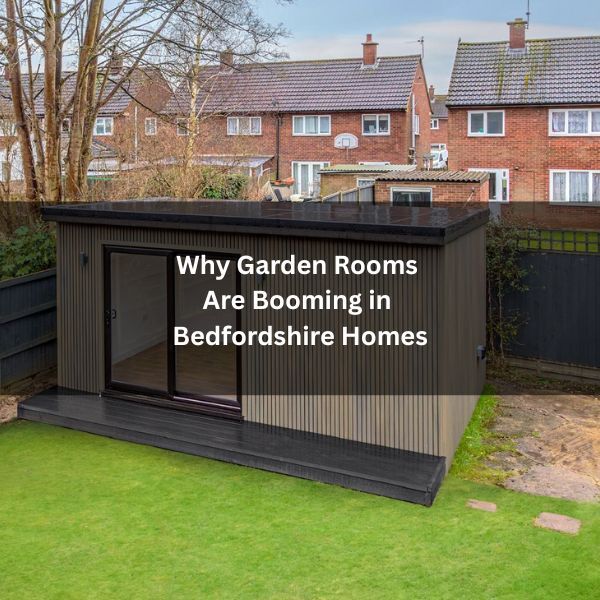
Garden rooms are appearing across Bedfordshire as hybrid work reshapes household priorities. Larger plots than in London make standalone offices practical, and residents want clear separation from home life. Towns like Biggleswade, Luton, Ampthill, and Bedford offer the space and demand, while resale value adds another incentive. Yet costs, planning constraints, and placement choices complicate the decision. The balance between lifestyle upgrade and investment is shifting, and the reasons behind that shift are becoming harder to ignore.
The post-pandemic working pattern that made “extra space” non-negotiable
For many households, hybrid working has moved from stopgap to standard. Office for National Statistics data indicates a sustained, meaningful minority splitting time between home and the workplace.
This entrenched pattern pressures domestic layouts: kitchen tables become contested desks, confidential calls collide with family noise, and ad hoc corners fail as professional backdrops. Bedrooms and living areas are already doing double duty, making internal reconfiguration costly and disruptive.
Garden rooms emerge as the least intrusive solution, adding a dedicated, quiet, and presentable workspace without sacrificing core rooms. They separate professional activity from household life, stabilising routines while supporting ongoing flexibility.
Why Bedford, Luton, Ampthill and Biggleswade are prime territory for garden offices
As hybrid routines bed in, the question shifts from whether extra space is needed to where it makes most sense.
Bedfordshire’s commuter towns combine professional job profiles with gardens larger than inner and outer London, making detached work studios practical. The “two-speed week” drives demand for a commute-like separation—an office in the garden—without trains.
Bedford offers fast London links and family plots suited to standalone rooms.
Luton prioritises value, with multi-use spaces doubling as side-business hubs or gyms.
Ampthill’s period streets favour designs sensitive to aesthetics and planning.
Biggleswade’s expanding family market seeks rapid installation, practical layouts, and insulated, year‑round usability.
Cost vs return: how to think about payback without overpromising
Payback needs a clear lens, not a promise. Readers should use a framework, not a single ROI figure.
Costs sit at the centre of that calculation, varying widely by specification, access, and ground conditions—an issue explored in more detail in our breakdown of how much garden rooms cost and what typically drives price differences.
First, benchmark cost against alternatives: loft conversion, extension, or internal reconfiguration. A garden room often delivers usable space faster and with fewer hurdles with Bedfordshire planning, but costs vary by spec and groundworks.
Return has two dimensions. One is valuation and saleability potential; the other is lived benefits: time saved on home days, fewer disruptions, and a dedicated workspace—an idea explored in more depth in how garden rooms can add value to Bedfordshire properties.
Align specification to the neighbourhood: avoid overbuilding for the street, yet don’t skimp on fundamentals—insulation, heating, power, light, and access—so the room is genuinely usable year-round.
Garden rooms as a value-and-saleability upgrade, not just a lifestyle purchase
While often framed as a lifestyle upgrade, a well-specified garden room is also read by buyers as practical, saleable space.
In Bedfordshire, purchasers typically interpret a finished unit as additional functional floor area, a turnkey home-working setup, and a flexible zone that can become an office, studio, gym, or teenage den.
Estate agent consensus suggests a measured value uplift, usually expressed as ranges rather than absolutes, contingent on specification and presentation.
Beyond headline numbers, marketability improves: listings with quality garden rooms tend to attract more viewings, create stronger online appeal, and differentiate comparable properties—particularly helpful in competitive micro-markets where small edges influence buyer decisions.
Planning, placement, and practicality in Bedfordshire gardens
Even before designs are chosen, siting a garden room in Bedfordshire hinges on privacy, orientation, and the relationship to boundaries.
Positioning should minimise overlooking, respect offsets, and capture the sun while avoiding glare or overheating. Larger glazing to the south and shading to the west help.
Acoustic comfort matters: high‑performance insulation, laminated acoustic glass, and sealed doors curb noise for calls.
Power and data need trenching, RCD‑protected circuits, and CAT6 or fibre; efficient heating and ventilation ensure year‑round use.
Planning note: many garden rooms fall under permitted development if within height and footprint limits. Rules vary—confirm specifics with Bedford Borough or Central Bedfordshire Council.
Conclusion
In Bedfordshire, the garden room rises like a quiet annex to modern life – a bridge between home and work, routine and possibility. With space to spare and hybrid habits now set, towns from Bedford to Biggleswade embrace these timber studios as clever investments as much as daily sanctuaries. When planned with care – siting, services, and scale—they add value that lingers. Not a fad, but a fixture: practical today, saleable tomorrow, and steadily rooting into the county’s way of living.